Illustration. Drawn for this file. The pictures here are not photographs of
anything and they carry no evidence — the atlas below is built from
source-linked records, and nothing in the artwork is one of them.
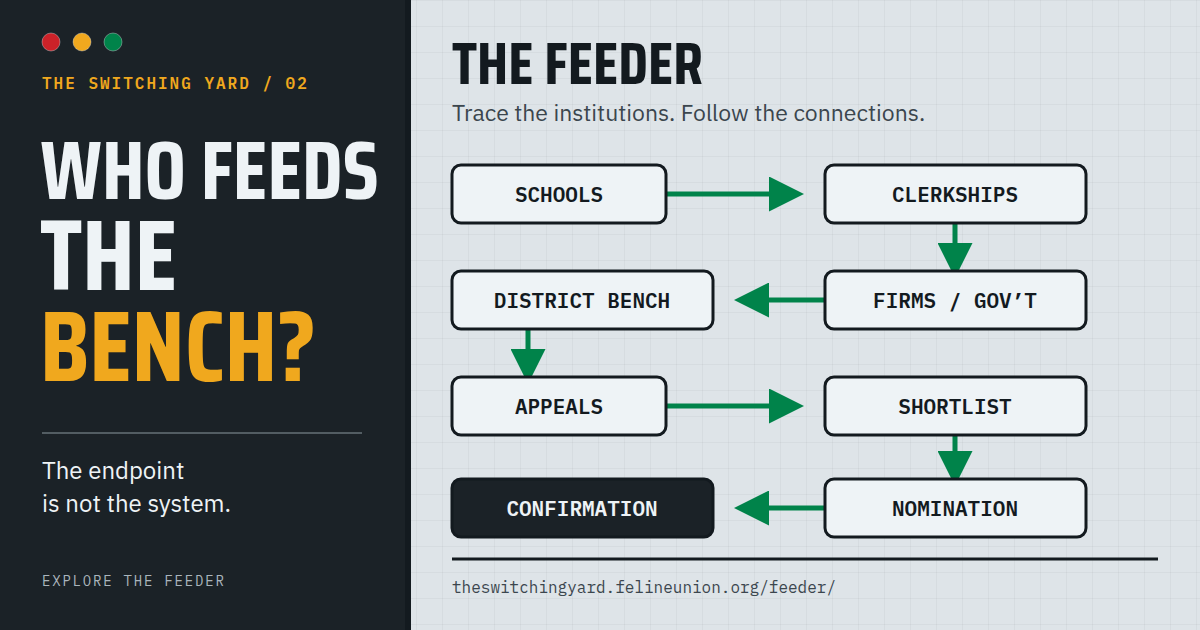
The endpoint is not the system. A Supreme Court shortlist can only draw from
the candidate pool produced beneath it. This yard follows the schools, clerkships,
firms, government offices, lower courts, publications and appointment gates that
make that pool.
The graph brings together source-linked records and documented working
connections. Identity classifications are never inferred from surnames;
connection, concentration and control remain distinct ideas.
Road 01
The atlas
Change the projection, explore the network, and select any node or connection to see its place in the record.
Three ways into the same network
Follow the connections
Choose a route. Each step highlights an existing connection and keeps its evidence status and source visible. Read at your own pace, or listen with the diagram following along.
Start beneath the appointment. Law schools and clerkships help organize the candidate pool. This school-to-clerkship connection is marked provisional: it is a modeled credential gate, not a compulsory route or a finding about every judge.
Clerkships can lead into law firms. This branch comes from the original network record, and keeps that recorded status. It is one route alongside academia and government, not a single conveyor belt that every candidate follows.
Recorded in the corpus · Undated · Original network record
From firms into government
The next recorded connection runs from firms into government legal offices, including the Solicitor General, the Office of Legal Counsel and Justice Department leadership. These offices build professional records and institutional connections; the graph does not turn that pattern into a requirement.
Recorded in the corpus · Undated · Original network record
The first judicial appointment
Government service can precede a district judgeship. This connection remains provisional because the attached official guide does not establish Justice Department service as a required path to the bench. Read the distinction before treating a career model as a rule.
District courts connect to the regional courts of appeals in the formal court hierarchy. The confirmed record describes appellate review of district-court judgments. That court relationship is not evidence that every appellate judge previously served as a district judge.
The recorded screening connection brings the appellate bench toward a shortlist. Recommendation, advocacy and presidential selection sit around this gate. A shortlist is a selection mechanism, not proof that any organization in another part of this network selected a particular judge.
Recorded in the corpus · Undated · Original network record
The formal confirmation gate
The route ends at a different kind of connection: Senate advice and consent for a Supreme Court appointment. That is a constitutional requirement, unlike the modeled career routes above. Use the sources and the judicial snapshots to distinguish formal gates from patterns in the candidate pool.
Begin with a person and a dated institutional roster. Detroit Federation's leadership list identifies Gary Torgow as immediate past president. This is a formal role connecting a named person to the Detroit organization, rather than an inference from proximity.
The same person appears as chair of the Jewish Federations of North America board. The shared leadership record connects Detroit and the continental federation structure. It does not by itself describe a personal relationship with CIJA.
The federation biography also identifies Torgow as chairman of Huntington Bank. That banking role belongs in the network alongside the federation roles. The attached record establishes the role, not a bank transaction involving CIJA or control of its activities.
A separate federation directory lists Detroit within the Jewish Federations of North America network. Directory inclusion and shared leadership are different records. Keeping them separate shows where the institutional route is supported without turning membership into a claim about governance power.
Detroit reports sending eighty percent of its emergency-campaign proceeds to the continental federation organization. This is a funding record, not merely a directory relationship. The attached record ends there: it does not trace those specific dollars onward to CIJA.
CIJA lists the Jewish Federations of North America among its partners and affiliated organizations. This completes an institutional route between CIJA and Detroit through the federation network. Partnership is the recorded relationship; its operational and financial terms are not specified here.
CIJA describes its core funding as coming from Jewish Federations through Jewish Federations of Canada and United Israel Appeal. That Canadian funding channel is a separate connection from Detroit's emergency-campaign transfer. Together the records locate CIJA as an organizational actor within the network, not simply as a media label.
Detroit's annual campaign allocation table also names seventy Faces Media, the publisher of the Jewish Telegraphic Agency. This opens the media-funding branch within the same graph. An allocation to a publisher is not evidence of editorial direction; the source record gives the amount and preserves that distinction.
Begin with a documented grant from Rothschild Foundation Hanadiv Europe to the Institute for Jewish Policy Research. The charity accounts establish a funding connection. They do not establish that the funder controls the research findings.
The Institute for Jewish Policy Research describes itself as co-leading NERON with the European University Institute. This is a research-policy network, not a law school, judicial clerkship or appointment gate. It belongs in the policy-production layer of the same atlas.
The European Commission's project record documents Horizon Europe funding for NERON. Private philanthropic support and public European funding therefore meet around the research infrastructure. These are distinct funding relationships, not evidence of shared control over an output.
The project record describes support for the European Union strategy on combating antisemitism and fostering Jewish life. This records an intended research-to-policy role. A purpose statement alone does not show that a recommendation was adopted, and Canada's named wider scope does not identify a Canadian project team.
A separate published report from the research institute cites the twenty eighteen Survey of Jews in Canada. This is the concrete Canadian data-use connection in the record. A citation does not make the survey's researchers NERON participants or establish a direct NERON-to-CIJA relationship.
The Canadian survey report identifies Robert Brym as a principal investigator. This named research role opens a different documented route into the Canadian policy apparatus. It is a personnel bridge between specific projects, not evidence that the earlier survey was commissioned by a later government office.
Canada's Special Envoy office commissioned Brym's separate survey about antisemitism in Ontario schools. The commission is distinct from the twenty eighteen Canadian survey. The graph can connect the researcher to both records without merging the projects or inventing a common funding source.
The Special Envoy office's annual report describes collaboration with CIJA. This provides a documented institutional connection at the Canadian end of the route. The chain consists of funding, project leadership, data use, research roles and collaboration. It does not establish a direct NERON-to-CIJA agreement or a judicial-appointment role.
The complete provisional record: every encoded node and relationship in one force-directed view.
UJA connects the media and nomination networks
In 1986, Daniel S. Shapiro, president of the predecessor Federation of Jewish Philanthropies, signed the merger agreement creating UJA-Federation of New York. A July 1987 NJCRAC memo names him as a co-chair of its Committee on Judicial Nominations during deliberations on Robert Bork.
UJA’s 2015–2016 grant report records $249,427 awarded to 70 Faces Media across four named programs. The publisher’s 2024–2027 strategic plan separately lists UJA as a foundational supporter. JTA belongs to 70 Faces Media; a separate 2024 JTA article reports a CIJA statement.
These records connect institutions across different periods. They do not establish that Shapiro directed the later grants, that the grants funded CIJA coverage, or that the media-support relationship influenced a judicial appointment. The supporter acknowledgment is not a grant amount or term.
Media funding across Detroit, New York and Canada
Detroit’s 2025 annual report lists a $15,000 allocation to 70 Faces Media, the nonprofit organization that publishes JTA. JTA’s existing client directory links it to Detroit Jewish News, and a separate 2024 article reports a CIJA statement. These are distinct funding, publisher, syndication and coverage relationships within the same network.
CANVAS lists both 70 Faces Media and The Canadian Jewish News as current media grantees. Its media-grant program supports coverage of Jewish creativity and artists. This shared grantmaking route connects the US publisher and the Canadian publication alongside JTA’s separately recorded CJN syndication relationship.
The allocation is to 70 Faces Media, not specifically to JTA. The records do not establish editorial direction, CIJA control of coverage, or republication of the cited article by Detroit Jewish News.
CIJA’s place in the federation network
CIJA is an organizational actor with documented advocacy, funding and partnership relationships. It lists JFNA as a partner; JFNA identifies CIJA as the Canadian federations’ advocacy arm and lists Detroit Federation in its directory. These records establish an institutional route between CIJA and Detroit through JFNA.
Direct Detroit funding, governance or direction of CIJA remains unestablished in the attached records. The institutional route does not establish CIJA’s involvement in judicial selection.
People, the assembly and funding
Gary Torgow links JFNA leadership, Detroit Federation and Huntington Bank through his recorded roles. Torgow and CIJA vice president Richard Marceau appeared in the same 2025 General Assembly opening plenary; the reports do not document an exchange between them.
Detroit reports sending 80% of its emergency campaign proceeds to JFNA and making separate direct allocations in Israel. Its $100,000 allocation to the Victims of Terror Fund converges with the fund’s broader JFNA/UIA support. The records do not trace Detroit’s specific dollars through that support.
The constitutional appointment is the final switch. The feeder begins much earlier, where admission, credential, employment and appointment gates narrow the field.
01
Law schools
Admissions, faculty sponsorship and the institutions that disproportionately feed clerkships.
02
Clerkships
Judges repeatedly place clerks into elite firms, government legal offices and later judicial consideration.
03
Firms
Recurring routes into the Solicitor General, OLC, DOJ leadership and White House Counsel.
04
Government
Offices where appellate records, executive trust and nomination networks accumulate.
05
District bench
The first Article III appointment and a public record of nomination and confirmation.
06
Appeals bench
The principal modern pool from which Supreme Court shortlists are assembled.
07
Shortlist
Recommendation, screening and advocacy before the formal nomination becomes public.
08
Confirmation
Presidential nomination and Senate consent convert the accumulated route into public authority.
Selection feeds the next round
Selected judges credential clerks, lawyers and future candidates; those credentials feed later appointments: selected → credentialed → appointed → authority → selects the next cohort.
Road 03
The record
The network spans publication, legal-policy, cross-border, judicial-selection and policy-production relationships. The policy-production projection remains analytically separate from judicial selection. Five snapshots—1991, 2000, 2010, 2020 and 2026—structure the longitudinal study.
Publication layer
The archive is also a node
JTA is the principal archival nexus. Detroit Jewish News, Canadian Jewish News and AJPA expose appointments, biographies, governance and cross-border institutional relationships.
1987 · Bork nomination
From committee review to Senate letter
The NJCRAC memo identifies Daniel S. Shapiro and Judge Jack B. Jacobs as co-chairs of its Committee on Judicial Nominations.
NJCRAC sent a letter to every member of the Senate Judiciary Committee, requesting scrutiny of Bork’s constitutional views.
The record documents committee work and advocacy; it does not establish control over the nomination or confirmation.
Formal federation, publication and international-governance structures connect the cities. Publication nodes are treated as sources and, where documented, as institutions in the network.
1991 representation
The debate at the endpoint
The historical succession discussed here runs Brandeis → Cardozo → Frankfurter → Goldberg → Fortas. Stephen Reinhardt’s 1991 argument addressed a restored “Jewish seat,” representation estimates and organizational lobbying.
Montreal layer
Federation, philanthropy and capital
The Montreal network intersects federation, philanthropic and capital structures across the Bronfman-era layer, alongside Lavy Becker and Jacob M. Lowy’s institutional connections.
Network result
Governance edges carry weight
In this sample, removing governance and organizational links fragmented the graph more than removing family, education or publication connections. Archive coverage is uneven.
Detroit↔New York↔Montreal↔Toronto↔Ottawa / international
Road 04
Bridge nodes
These people connect otherwise separate parts of the provisional graph. A bridge is a topological description—not a claim that the person directed the network.
Road 05
Parked branch
The charity-revocation investigation tested whether removing one institution destroys the surrounding network. It produced useful controls, but it is not evidence about the judicial feeder.
Held out of the main line.The branch remains documented here so it cannot quietly return later as if it had proved the original claim.
Regeneration case
JNF → Friends of JNF
An existing charity was renamed to perform similar work after revocation, with old-board endorsement and personnel and infrastructure continuity.
Attempted transition
Ne’eman → Emunim
Federal Court material records an executive bridge, same-address restructuring and an expressed intention to transfer operations. CRA later intervened against the receiving node.
Control cases
Sigma Chi and WE
Sigma Chi and WE show that corporate survival, international networks, adjacent entities and enforcement latency also appear in other cases.
Continuing infrastructure
Canada Charity Partners → IsraelGives
After CRA revoked Canada Charity Partners, IsraelGives pages continued to identify it as a Canadian partner and display Canadian donation language. A completed post-revocation official receipt is not in this record.
Redirection
Masorti → MERCAZ-Canada
After CFMJ revocation, Masorti directed supporters to MERCAZ-Canada and stated that donations would not receive a CRA-recognized receipt.
Parallel structure
CZCA / ASI-Canada
The comparison tracks parallel charitable and non-charitable structures as CZCA and ASI-Canada followed separate paths.
Control case
WE Charity
WE Charity provides a comparison for preservation and decomposition without an equivalent reconstruction of the former Canadian flagship.
Road 06
Bench snapshots
Two published estimates provide historical context but are not directly comparable. The roster now contains appellate-bench membership at five fixed dates, with linked career and education records for the judges represented in those snapshots.
1991 · JTA report≈10%
Among 165 federal appellate judges, as reported in Stephen Reinhardt’s interview.
These are estimates reported at different times, not a like-for-like series.
Five fixed-date snapshots
1991→2000→2010→2020→2026
Before appellate appointment
Career-path records
Counts show dated Federal Judicial Center biography entries before each judge’s appellate commission. Select a category to view the matching judge records. These documented career paths do not by themselves establish influence or causation.
Loading career records…
Education pathway
Law schools in the roster
Most frequently listed law schools in the selected bench. Counts use education records that identify a law degree; missing entries are not counted as zero. Select a school to see the associated judge records.
Browse active appellate service as of January 1 for each snapshot year. Search names, filter circuits, and open a record for federal judicial service, education and professional history. Background classifications are not inferred from these records.
Loading the judge roster…
Fields required for every judge
Circuit · appointment date · appointing president · district-court service · government service · firm · law school · clerkships · academic positions · documented organizational relationships · background classification · sources.
Classification rule: religious, ethnic and ancestry classifications require documentary support. They are never inferred from names or association alone.
Share The Feeder
Send the investigation, or save its graphic for a social post.